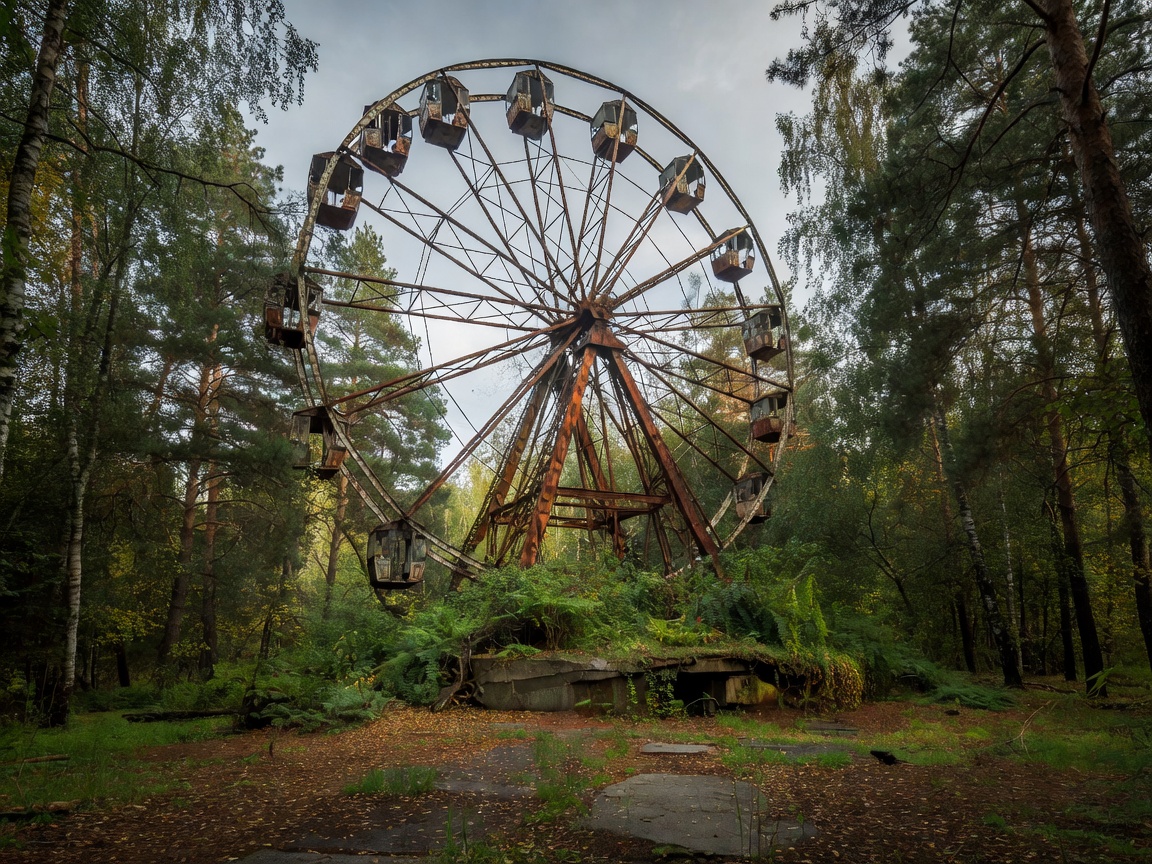
1. The 36-Hour Evacuation
Founded in February 1970 to house the operating personnel of the Chernobyl Nuclear Power Plant, Pripyat was designed as a model "Atomgrad." With wide boulevards, 160 residential apartment towers, 15 primary schools, and modern sports complexes, the city’s average citizen age was just 26 years.
On the afternoon of April 27, 1986—thirty-six hours after the disaster at Reactor No. 4—a fleet of 1,200 buses lined the highway. A 130-word radio broadcast informed citizens to pack three days of provisions. None of the 49,360 residents ever returned.
"The absence of human hunting, traffic, and agricultural development has proven vastly more influential on wildlife resurgence than radiation has on suppressing it."
2. Radical Forest Colonization
Without groundskeepers and street sweeping, seeds of silver birch (Betula pendula) and Scots pine (Pinus sylvestris) took root in tarmac seams. Today, Lenin Avenue is an unbroken forest canopy where trees grow four stories tall through concrete courtyards.
Roofs in Pripyat are collapsing not primarily from age, but from the immense root-wedge pressure of full-grown trees whose root networks pry apart reinforced concrete floor slabs.
3. Apex Predator Resurgence
The 2,600 km² Exclusion Zone is now populated by thriving packs of Eurasian wolves (Canis lupus), endangered Eurasian lynx, brown bears, and herds of reintroduced endangered Przewalski horses. Camera traps record healthy population densities comparable to untouched national parks.