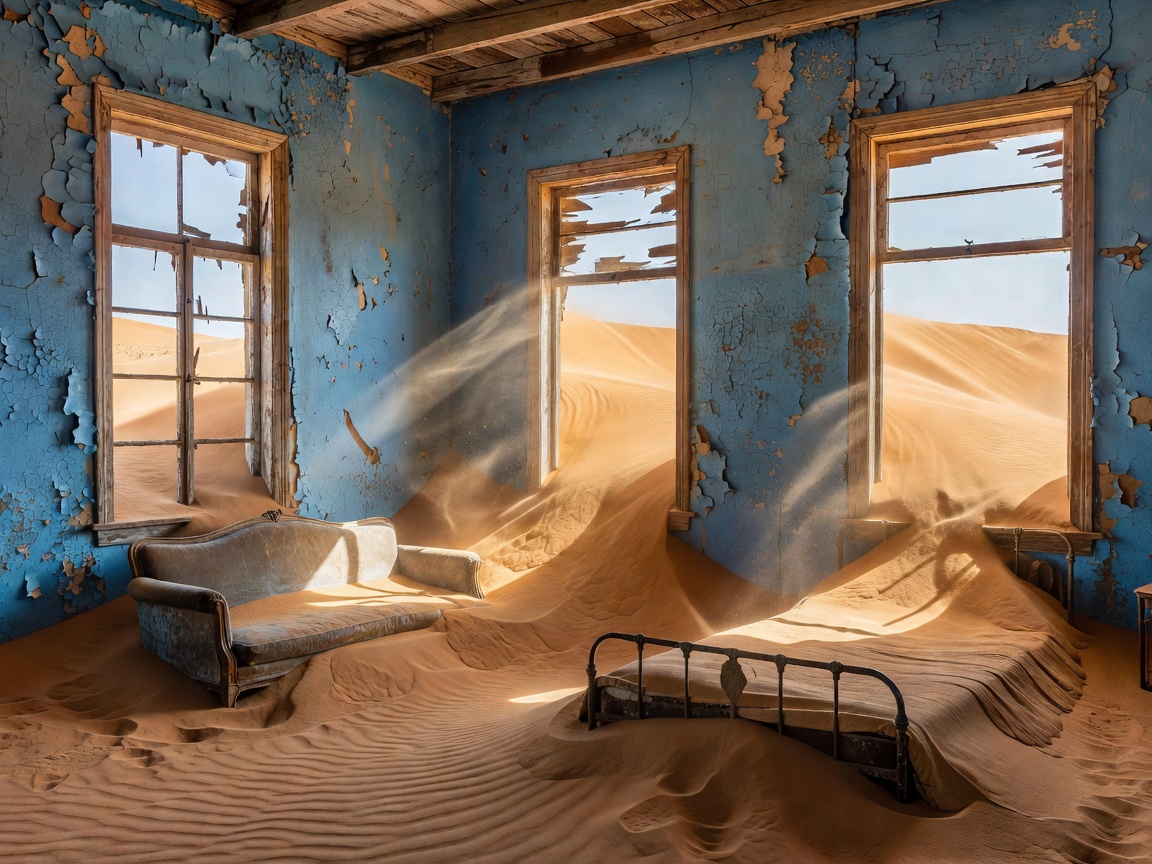
1. Discovery in the Forbidden Sperrgebiet
In 1908, railway worker Zacharias Lewala discovered a shimmering crystal in the gravel plains near Lüderitz and showed it to his supervisor, August Stauch. Verified as a diamond of extraordinary clarity, the colonial German government declared the region a Sperrgebiet (Forbidden Area), barring unauthorized access across 26,000 square kilometers of desert wilderness.
Within two years, an isolated mining outpost materialized out of the dunes into a luxurious town modeled after a Bavarian suburb. Despite having no natural freshwater source within hundreds of kilometers, Kolmanskop enjoyed electric power, an ice factory, a lemonade plant, a four-lane bowling alley (Kegelbahn), an opera stage with acoustics imported from Berlin, and the first X-ray diagnostic machine in the southern hemisphere.
"In the mornings, railway tankers brought millions of gallons of fresh water from Cape Town, while in the evenings, diamond millionaires drank chilled champagne surrounded by shifting barchan dunes."
2. The Collapse and Surrender to the Dune Sea
The prosperity was ephemeral. By the late 1920s, the diamond deposits near Kolmanskop were depleting. In 1928, vastly richer alluvial diamond fields were discovered 270 kilometers south at the mouth of the Orange River near Oranjemund. The exodus was decisive. Mining operations scaled down throughout the 1930s and 1940s, and by 1956, the final resident locked their villa door and departed.
With maintenance halted, the persistent south-southwest winds (the Southerlies) began driving tonnes of quartz sand through glass windows, cracked door frames, and ornamental eaves. Today, whole rooms are submerged up to three meters deep in pristine sand dunes that mirror the larger desert outside.
3. Architectural Decay Dynamics
The extreme dryness of the Namib Desert (averaging less than 15mm of precipitation per year) has slowed biological rot, yet the abrasive salt-laden ocean fog creates a unique mechanism of erosion known as aeolian salt-sand blasting. Wooden lintels are scoured until the natural grain stands out like relief maps, and imported floral wallpapers hang in sun-bleached parchment ribbons.
- Structural State: 65% of domestic roofs collapsed; stone basements intact.
- Vegetation: Zero natural flora inside buildings due to hyper-salinity and hyper-aridity.
- Fauna: Occasional brown hyenas (Parahyaena brunnea) and desert horned adders use the shaded doorways for shelter.