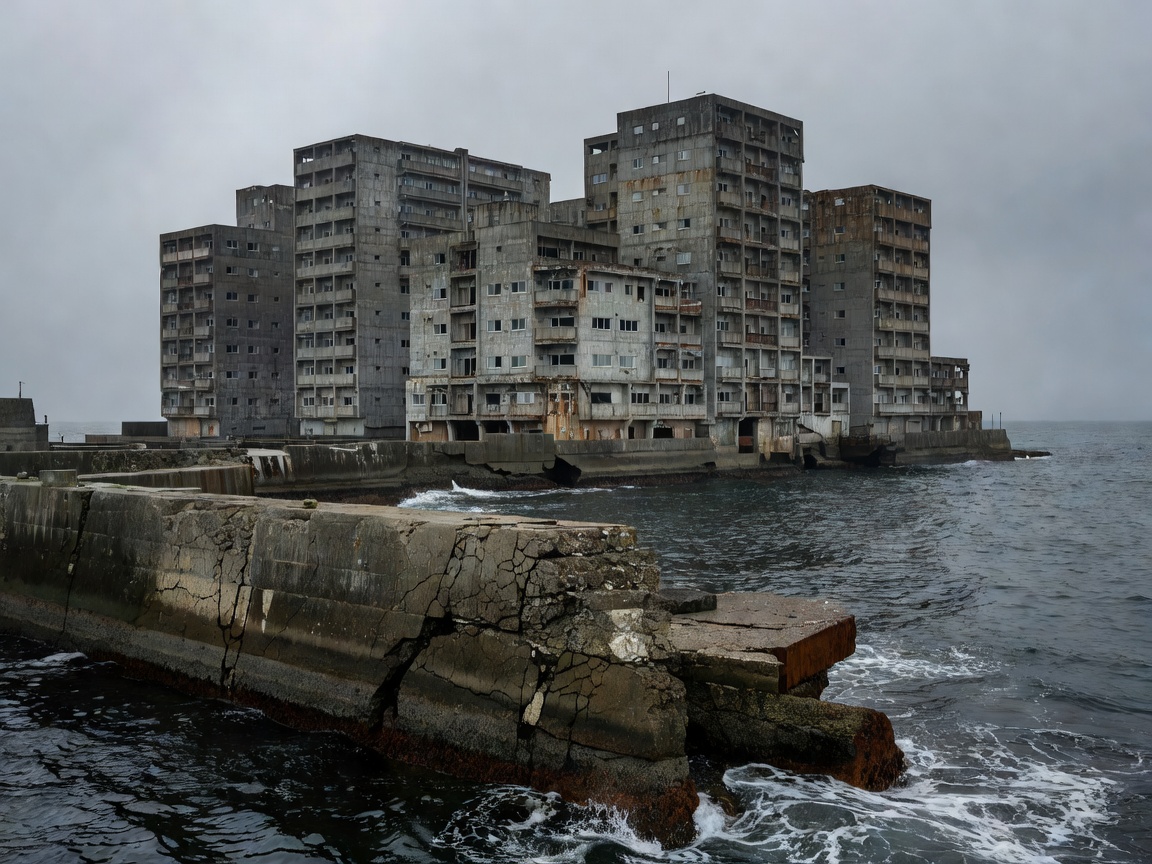
1. The Undersea Coal Colossus
Hashima Island, located 15 kilometers southwest of Nagasaki, began as a reef outcrop. In 1890, the Mitsubishi Corporation purchased the rock and undertook massive land reclamation, encasing the 6.3-hectare perimeter with high seawalls designed to mimic the hull of the battleship Tosa.
Miners descended over 1,000 meters beneath the seafloor in vertical shafts where temperatures exceeded 30°C and humidity hovered at 95% to extract high-grade metallurgical coal. To house the thousands of miners and their families, Japan's earliest reinforced concrete multi-story apartment blocks were constructed here starting in 1916 (Building No. 30).
"Hashima was a self-contained concrete hive: schools, hospital, cinema, communal baths, and rooftop gardens linked through an interconnected labyrinth of aerial skywalks."
2. Rapid Evacuation in 1974
As petroleum permanently replaced coal across the Japanese energy grid, the mine became commercially unsustainable. On January 15, 1974, Mitsubishi announced the definitive closure of the shafts. By April 20, 1974, the last transport barge cleared the dock, instantly reducing the island's population from over 5,000 to zero.
Because residents were provided subsidized transport with tight luggage weight limits, most furnishings, televisions, sewing machines, school desks, and laboratory equipment were abandoned in place.
3. Chloride Attack & Atmospheric Degradation
Hashima stands as a premier empirical laboratory for the study of chloride-induced rebar corrosion. Without human maintenance, airborne sea spray penetrates the porous concrete, oxidizing the internal iron rebar. The expanding rust exerts tensile stress on the surrounding concrete, leading to spalling, column shear failures, and staircase collapses.